Eterna Vitality & Wellness™
Reverse Disease.
Extend Healthspan.
Optimize Vitality.
MONDAY - THURSDAY 10:00am - 6:00pm EST
FRIDAY, SATURDAY and SUNDAY: CLOSED
BLOG
Wellness Your Way with Dr. Renée
Hair loss is a signal, not a diagnosis. The 6 Hair Restoration Strategies Most Physicians Overl
Hair Loss is a Signal, Not a Diagnosis:
The 6 Hair Restoration Strategies Most Physicians Overl
More hair in the drain. A ponytail that feels thinner. A part that looks wider than it used to. You mentioned it to your doctor, and the conversation ended at "stress, maybe aging, try biotin." Not because the answer does not exist — but because nobody looked for it.
Hair loss is a signal, not a diagnosis
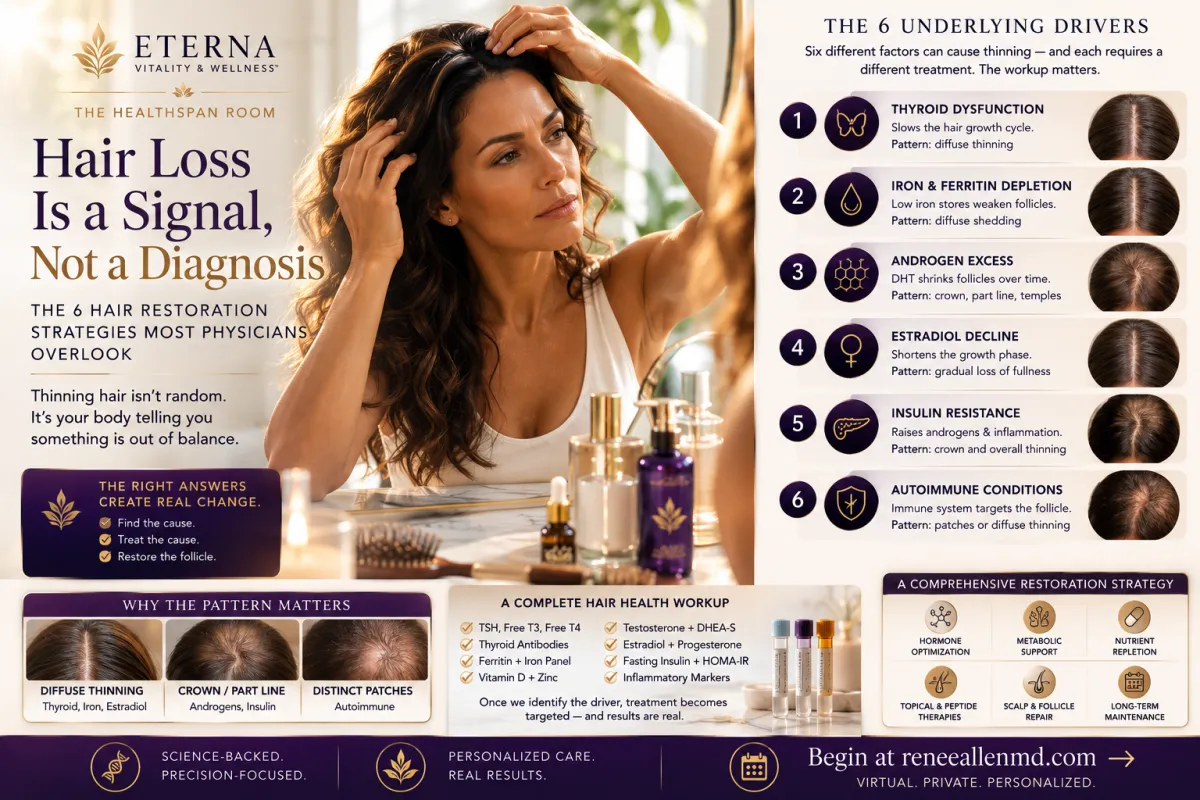
Thinning means something in your body is creating an environment where your follicles cannot function the way they should. But the "something" is not the same for every woman. Six different drivers can produce thinning, and each requires a different treatment. The diagnostic workup matters more than any product you could buy.
The six drivers
1. Thyroid dysfunction. Your thyroid controls the growth cycle of every follicle. When function slows, even subtly, texture changes first, then growth slows, then shedding increases. A standard screen checks only TSH; a complete panel includes free T3 (the active hormone follicles use), free T4, and thyroid antibodies. Pattern: diffuse thinning across the scalp.
2. Iron and ferritin depletion. Hemoglobin tells you whether you are anemic; ferritin tells you whether your iron stores are adequate for hair growth. Many women have normal hemoglobin and a ferritin too low to sustain healthy follicles. Pattern: diffuse shedding, hair feeling finer overall.
3. Androgen excess. When androgens like testosterone and its derivative DHT rise too high — or when follicles are genetically sensitive to normal levels — the follicle gradually shrinks. This drives most PCOS-related hair change and can also stem from insulin resistance. Pattern: thinning at the crown, part line, or temples, often with jawline acne.
4. Estradiol decline. Estradiol extends the active growth phase. As it declines in perimenopause and beyond, that phase shortens and density gradually reduces. No dramatic shedding event — just a slow loss of fullness.
5. Insulin resistance. Excess insulin stimulates the ovaries and adrenal glands to produce more androgens and raises inflammation at the follicle. Standard glucose tests often look normal while insulin is already elevated; fasting insulin and HOMA-IR reveal the full picture. Pattern: overlaps with the androgen pattern, because the two are mechanistically linked.
6. Autoimmune conditions. The immune system can target the follicle directly (alopecia areata) or affect hair through thyroid disruption or systemic inflammation. Pattern: distinct patches, or diffuse thinning depending on the condition.
Why the pattern matters
Where and how your hair is changing narrows the diagnosis before a single lab is drawn. Diffuse thinning points toward thyroid, iron, or estradiol. Crown and part-line thinning suggests androgens or insulin. Distinct patches suggest autoimmune involvement. The pattern makes the lab workup targeted instead of generic.
What a comprehensive evaluation includes
A complete thyroid panel (TSH, free T3, free T4, antibodies); ferritin, serum iron, and iron binding capacity; free and total testosterone and DHEA-S; estradiol and progesterone; fasting insulin and HOMA-IR; vitamin D and zinc; and inflammatory or autoimmune markers as indicated. Once the labs identify the driver, treatment becomes specific — and for most women, the strongest results come from addressing the internal cause and supporting the follicle directly at the same time.
Biotin is not a diagnosis. If your hair has been thinning and no one has run the labs that explain it, that is the place to start. At Eterna Vitality & Wellness, we evaluate the full hormonal and metabolic picture behind hair change in a private virtual consultation and build treatment around the actual cause. Begin at reneeallenmd.com.
Sign Up for Our Newsletter
Weekly Free Meal Plans!
Sign up for our newsletter to receive tips, wellness inspiration, and updates about our services.
Join our community and take the first step towards a healthier, more balanced life.


Subscribe to the Eterna Mailing List
And that’s just a glimpse of what’s possible when medicine meets integrative science. Join my mailing list to receive exclusive wellness insights, hormone optimization tips, and evidence-based guidance — straight from Dr. Renée.