
Eterna Vitality & Wellness™
Reverse Disease.
Extend Healthspan.
Optimize Vitality.
MONDAY - THURSDAY 10:00am - 6:00pm EST
FRIDAY, SATURDAY and SUNDAY: CLOSED
BLOG
Wellness Your Way with Dr. Renée
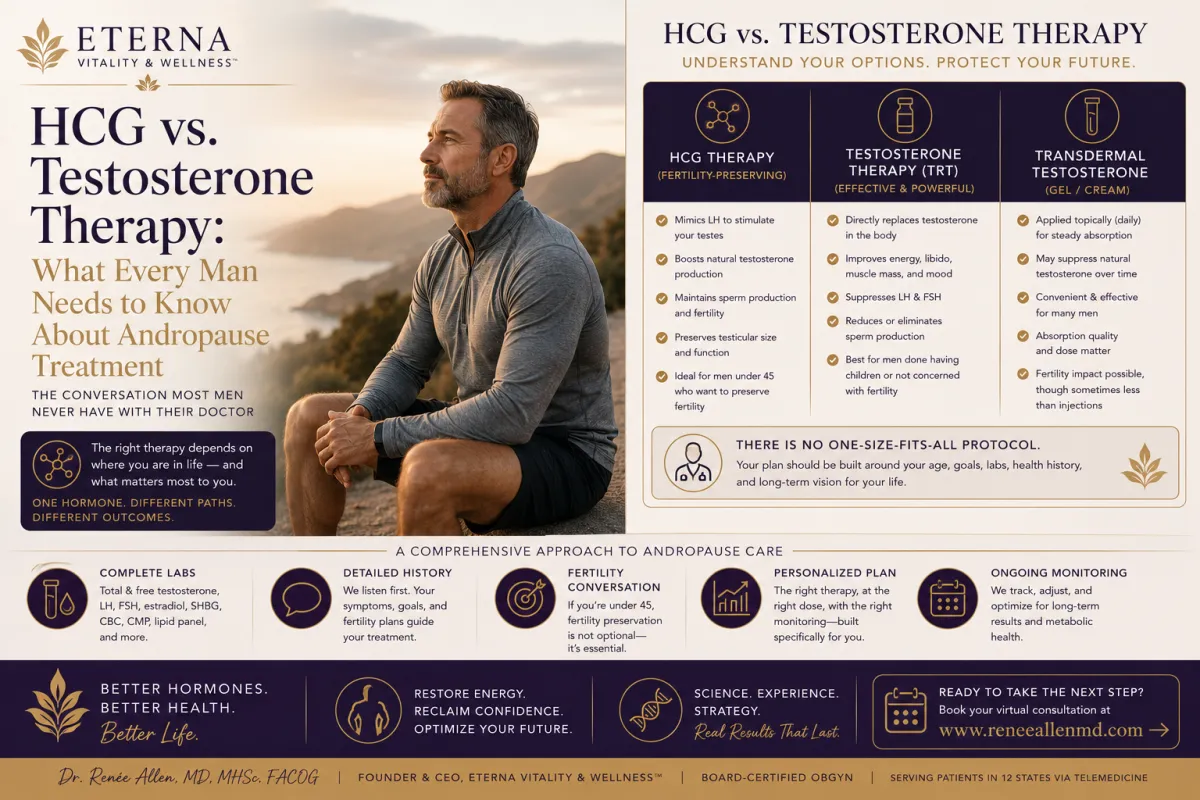
HCG vs. Testosterone Therapy: What Every Man Needs to Know About Andropause Treatment
HCG vs. Testosterone Therapy: What Every Man Needs to Know About Andropause Treatment
The Conversation Most Men Never Have with Their Doctor
If you've been told your testosterone is low, the next step seems obvious: start testosterone therapy. But what if that approach — for the wrong man at the wrong stage of life — could permanently compromise his fertility? And what if there's a better first conversation to have?
While reviewing clinical protocols for a new practice I've been hired on as a strategic advisor this week, I was reminded of something I've always known but that conventional medicine consistently gets wrong: andropause treatment is not one-size-fits-all. The distinction matters enormously depending on who you are and what you want your future to look like.
What Is Andropause?
Andropause — sometimes called "male menopause" — is the gradual decline in testosterone and other hormones that occurs as men age, typically beginning in the late 30s to 40s. Symptoms include fatigue, reduced libido, brain fog, mood changes, difficulty building or maintaining muscle, and increased body fat.
Unlike the relatively abrupt hormonal shift of female menopause, andropause unfolds slowly and is often dismissed by physicians as "just aging." The result? Millions of men suffer unnecessarily from symptoms that are both measurable and treatable.
Why the "Just Start TRT" Approach Falls Short
Testosterone Replacement Therapy (TRT) — through injections of testosterone cypionate or enanthate, transdermal gels and creams, or other delivery systems — is highly effective for many men. But here's the critical nuance:
Exogenous testosterone suppresses the body's own production of LH (luteinizing hormone) and FSH (follicle-stimulating hormone). This suppresses both endogenous testosterone production in the testes and, critically, sperm production.
For a 60-year-old man who is done having children and wants to reclaim his energy, cognition, and vitality — TRT may be an excellent choice.
For a 38-year-old man who wants to preserve his fertility and protect long-term testicular function — TRT alone is not the right starting point.
One protocol. Two completely different outcomes.
HCG Therapy: The Fertility-Preserving Option
Human Chorionic Gonadotropin (HCG) mimics LH in the body, stimulating the testes to produce their own testosterone while simultaneously maintaining sperm production. For younger men who want to preserve fertility, HCG is often the first-line intervention.
Benefits of HCG therapy in appropriate candidates include:
Maintenance of testicular size and function
Preservation of sperm production
Stimulation of endogenous testosterone production
Compatibility with combination therapy (HCG + TRT) to mitigate fertility effects
Enclomiphene: Another Fertility-Sparing Alternative
Enclomiphene is a selective estrogen receptor modulator (SERM) that blocks estrogen's negative feedback on the pituitary, prompting an increase in LH and FSH — and subsequently, a rise in the body's own testosterone. Unlike clomiphene citrate, enclomiphene offers a cleaner option by isolating the active trans-isomer, avoiding the estrogenic side effects of its zuclomiphene counterpart.
Enclomiphene can be used alone or combined with HCG in younger men who want to maximize fertility preservation while addressing symptomatic low testosterone.
What About Transdermal Testosterone?
Transdermal testosterone — applied as a gel or cream, often to the scrotum for enhanced absorption — remains a viable clinical option. However, even transdermal testosterone can suppress the HPG axis over time, though sometimes to a lesser degree than injectable forms. Concentration, dosing frequency, and patient goals all factor into whether this delivery mechanism is appropriate.
The Right Approach Is Individualized
Here's what I want every man reading this to understand: your hormone optimization plan should be built around you — your age, your health history, your fertility goals, your lifestyle, and your long-term vision for your health.
That means working with a physician who:
Takes a detailed history before writing a prescription
Runs comprehensive labs — total and free testosterone, LH, FSH, estradiol, SHBG, complete metabolic panel, and more
Has an explicit conversation about fertility preservation if you're under 45
Has a structured monitoring and dose-adjustment protocol
Stays current on the evolving science of andropause and longevity medicine
If your current provider isn't having this conversation with you, it may be time to find one who will.
Ready to Have a Smarter Conversation About Your Hormones?
At Eterna Vitality & Wellness, I provide personalized, evidence-based andropause care for men across 12 states. Whether you're just beginning to notice symptoms or have already tried treatment that didn't feel right, I'd love to review your case and create a plan that's actually built around you.
Visit reneeallenmd.com to learn more or schedule a consultation.
— Dr. Renée Allen, MD, MHSc, FACOG | Founder & CEO, Eterna Vitality & Wellness™
Sign Up for Our Newsletter
Weekly Free Meal Plans!
Sign up for our newsletter to receive tips, wellness inspiration, and updates about our services.
Join our community and take the first step towards a healthier, more balanced life.



Subscribe to the Eterna Mailing List
And that’s just a glimpse of what’s possible when medicine meets integrative science. Join my mailing list to receive exclusive wellness insights, hormone optimization tips, and evidence-based guidance — straight from Dr. Renée.